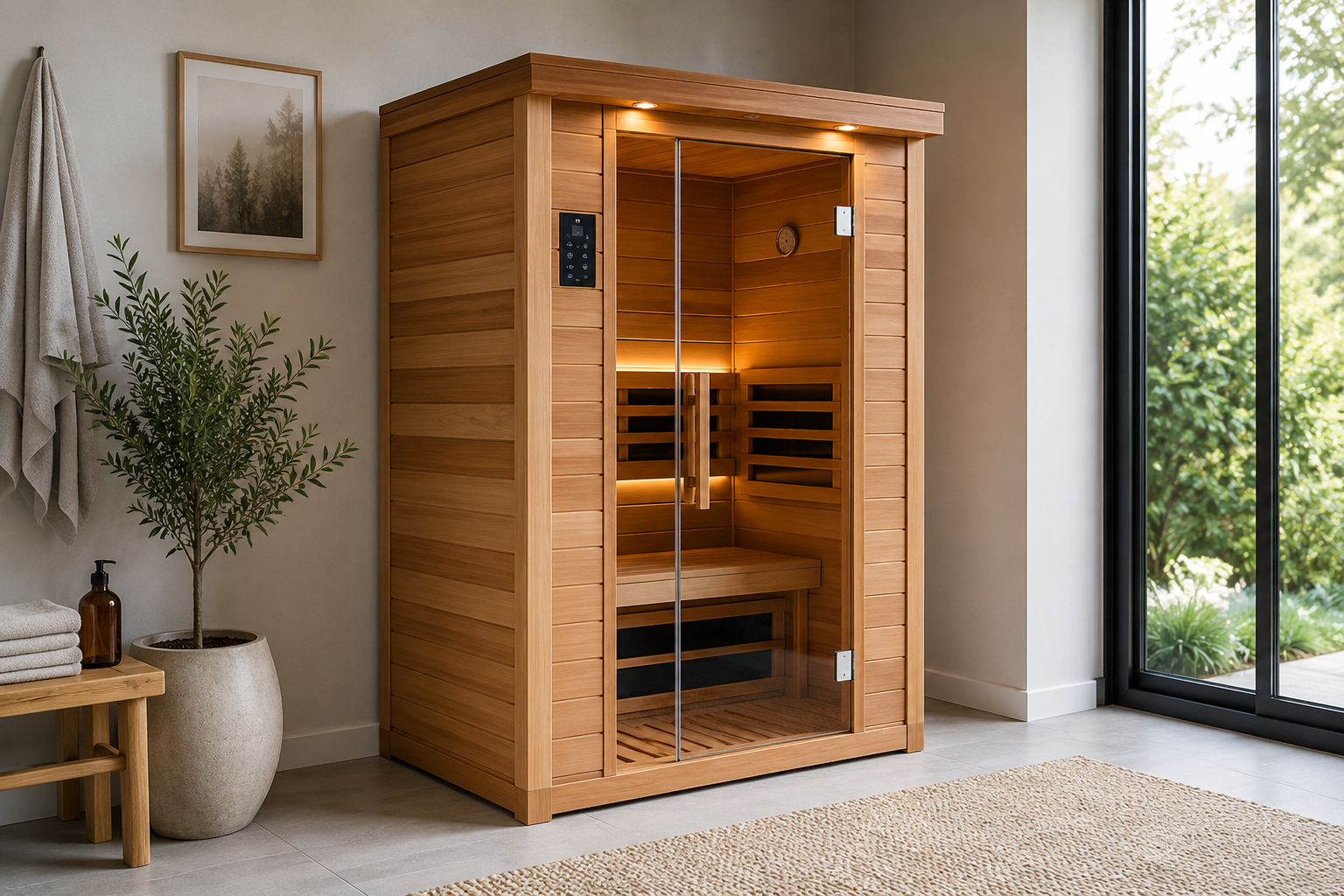
Electrical requirements are one of the easiest details to overlook when comparing an infrared sauna—and one of the most important to confirm before delivery. Some compact models can use a standard household outlet. Larger cabins may need a dedicated 20-amp circuit or a 240-volt connection installed by a licensed electrician.
The short answer: check the manufacturer’s voltage and amperage specification for the exact model, confirm whether the circuit must be dedicated, and have a qualified electrician verify the intended location before ordering. Do not assume that an outlet is suitable because the plug appears to fit.
Affiliate disclosure: Sorene & Stone may earn a commission if you purchase through links on this page, at no additional cost to you. We only feature products that fit our editorial focus.
The three common electrical setups
| Typical setup | What it usually means | Planning note |
|---|---|---|
| 120V / 15A | Common on compact one-person saunas | May work with a standard outlet, but the manufacturer’s instructions still control |
| Dedicated 120V / 20A | Common on larger one- or two-person cabins | Usually needs a dedicated 20-amp circuit and matching receptacle |
| Dedicated 240V | Often required for larger cabins with more heaters | Usually requires advance electrical planning and professional installation |
What “dedicated circuit” means
A dedicated circuit serves the sauna rather than sharing power with lights, televisions, gym equipment, space heaters or other outlets. This matters because an infrared sauna draws a meaningful load for an extended period. Sharing the circuit can lead to nuisance breaker trips and may conflict with the manufacturer’s installation requirements.
The outlet’s appearance does not tell you everything about the wiring behind it. An electrician can confirm the circuit rating, wiring, grounding, receptacle and available panel capacity.
Why sauna size changes the requirement
More interior space generally means more heating panels and a higher electrical load. That is why a compact one-person cabin may use 120V/15A while a three-person model may require 240V. Added features can also affect the model’s overall specification, so compare the exact product manual rather than relying only on capacity.
A real-world comparison: Shasta, Fuji and Matterhorn
Peak Saunas’ indoor range shows how requirements can change as the cabin grows:
- Shasta, one person: 120V / 15A
- Fuji, two people: dedicated 120V / 20A
- Matterhorn, three people: dedicated 240V / 20A
Read our full Shasta vs Fuji vs Matterhorn comparison for dimensions, materials and the best fit for each household.
Five checks to make before ordering
- Find the exact model specification. Confirm voltage, amperage, plug type and whether a dedicated circuit is required.
- Choose the final location. The electrician needs to assess the actual room, outlet position and path to the electrical panel.
- Check the circuit—not just the outlet. A familiar-looking receptacle does not confirm that the circuit is appropriate.
- Plan outlet placement. Follow the manufacturer’s clearance and cord-placement instructions; avoid creating a setup that depends on an extension cord.
- Complete electrical work before delivery. It is much easier to prepare the circuit before a large cabin is assembled in the room.
Room-by-room considerations
Bedroom or spare room
Confirm that the circuit is not already serving several outlets or high-draw devices. Measure the full cabin footprint, door swing and assembly clearance as well as the delivery route.
Home gym
Treadmills, heaters and other equipment can place substantial demand on a shared circuit. A dedicated sauna circuit helps keep the setup clear and predictable.
Garage or outdoor structure
Temperature, moisture, local code requirements and the manufacturer’s approved placement all matter. Confirm that the exact model is suitable for the environment; an indoor sauna should not be treated as weather-rated equipment.
Questions to ask the manufacturer
- What voltage and amperage does this exact model require?
- Must the circuit be dedicated?
- What receptacle and plug configuration are specified?
- Where should the outlet be positioned relative to the cabin?
- Is professional electrical installation required for warranty coverage?
- Are extension cords or power strips prohibited?
The bottom line
Start with the room and the electrical supply before choosing sauna capacity. A 120V/15A model may offer the simplest path for a compact setup, while a dedicated 20A or 240V model can make sense when additional space and heating capacity justify the preparation. Confirm every requirement for the exact model and use a licensed electrician for site-specific advice and any new electrical work.
For a broader look at heat type, placement, materials, installation, warranties and delivery, continue with our complete home sauna buying guide.
Specifications can change. Confirm current requirements with the manufacturer before purchase. This article provides general information and is not a substitute for manufacturer instructions, local electrical requirements or advice from a qualified electrician.
Leave a Reply